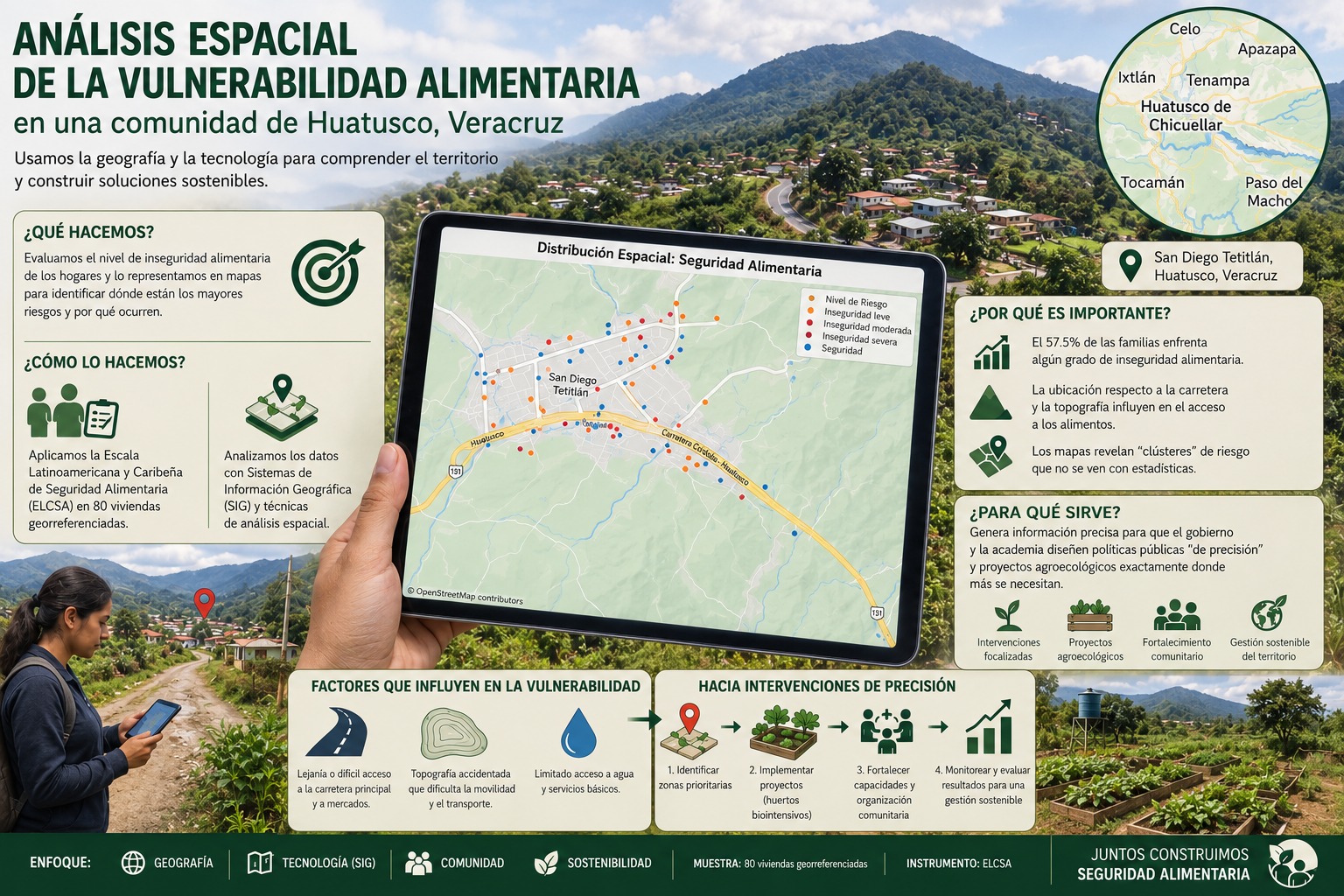
un Spatial analysis of food vulnerability in a community in Huatusco, Veracruz.
Keywords:
Biointensive agriculture, food vulnerability, geographic information systems, participatory engineering, spatial analysis, food sovereigntyAbstract
Understanding the distribution of hunger in the territory turns out to be important for its eradication, given that food vulnerability is not a static phenomenon but responds to highly specific socio-spatial, economic, and topographic dynamics. This research aimed to map food risk in the town of San Diego Tetitlán, municipality of Huatusco (Veracruz), and to structure a technical proposal for participatory vertical biointensive agriculture aimed at its mitigation. An observational, cross-sectional, and spatial methodological design was applied, combining Geographic Information Systems (GIS) with the Latin American and Caribbean Food Security Scale (ELCSA) metric in a probabilistic and georeferenced sample of 80 households. In the territorial diagnostic phase, results showed that 57.5% of households exhibit some level of food insecurity (42.5% mild, 7.5% moderate, and 7.5% severe). Bivariate statistical analysis revealed a deep intersectionality driven by the gender gap: female-headed households were twice as likely to suffer moderate or severe insecurity compared to their male counterparts (16.94% vs. 9.52%). Likewise, a direct correlation between educational lag and extreme vulnerability was evident. Spatial analysis identified acute risk clusters confined to areas with the greatest isolation from the main communication route, demonstrating that topographic marginalization acts as a catalyst for shortages and configures micro-local food deserts. As a direct response to this diagnosis, the design of vertical hydroponic modules adapted to the environment's conditions is theoretically grounded. It is concluded that superimposing spatial analysis with participatory agroecological strategies is crucial to overcoming welfare-based government approaches, allowing for future precision resource targeting to restore community food sovereignty.