
Fotocatálisis y sostenibilidad: Soluciones científicas para la remediación ambiental y la energía limpia
Photocatalysis and sustainability: Scientific solutions for environmental remediation and clean energy
DOI:
https://doi.org/10.82580/revateh.v2i2.36Keywords:
Hidrotalcitas, Fotocatálisis, Producción de hidrógeno, Remoción de arsénico, Reducción de CO2.Abstract
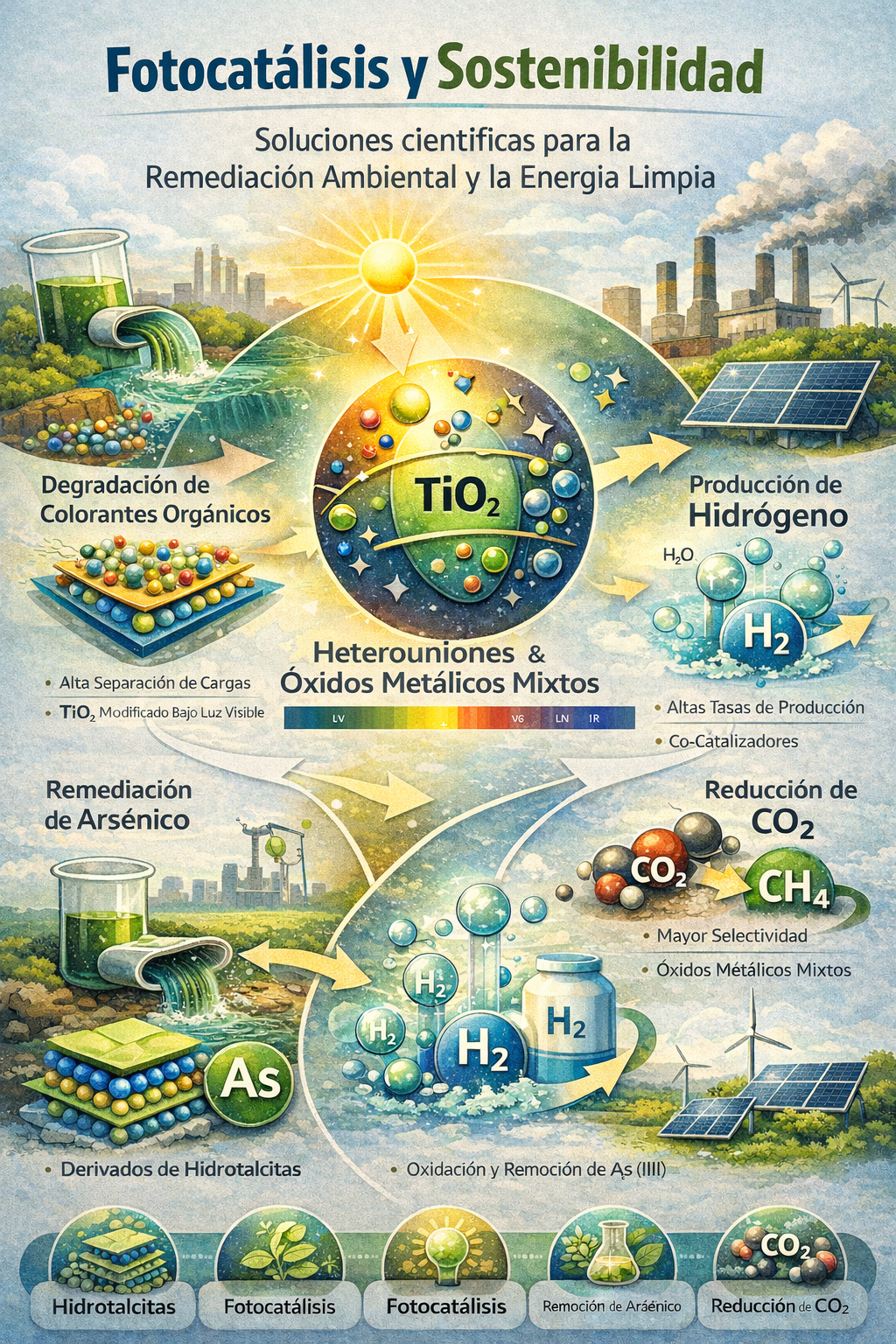
Heterogeneous photocatalysis has emerged as a promising strategy to simultaneously address environmental pollution and energy challenges associated with the intensive use of fossil fuels. This bibliographic review provides an integrated analysis of the role of semiconductor materials in several photocatalytic applications, including the degradation of organic dyes, arsenic oxidation in aqueous media, photocatalytic hydrogen production, and carbon dioxide reduction.
The reviewed studies demonstrate that photocatalytic efficiency strongly depends on the structural and electronic design of the materials, rather than solely on the base semiconductor. In dye degradation processes, the modification of TiO2 through inert supports and visible-light-active heterojunctions enhances charge separation and improves catalyst stability. In the case of arsenic remediation, a clear evolution is observed from systems focused exclusively on As(III) oxidation toward materials derived from layered double hydroxides that combine oxidation and contaminant retention within a single platform.
Regarding energy-related applications, the analyzed works show that high hydrogen production rates and improved CO2 reduction selectivity can be achieved through rational heterojunction design, the use of co-catalysts, and mixed metal oxides derived from layered double hydroxides. Overall, this review highlights that the development of multifunctional materials and integrated design strategies is essential for advancing photocatalytic technologies toward sustainable and practical applications.
Additional Files
Published
Versions
- 2026-05-07 (2)
- 2026-05-07 (1)